| Submission |
| Author Guidelines |
| Reviewer Guidelines |
| Article Processing Charge |
| Open Access Statement |
| Focus and Scope |
| Publication Etics |
| Screening Plagiarsm |
| Journal Licence |
| Editor Assessment |









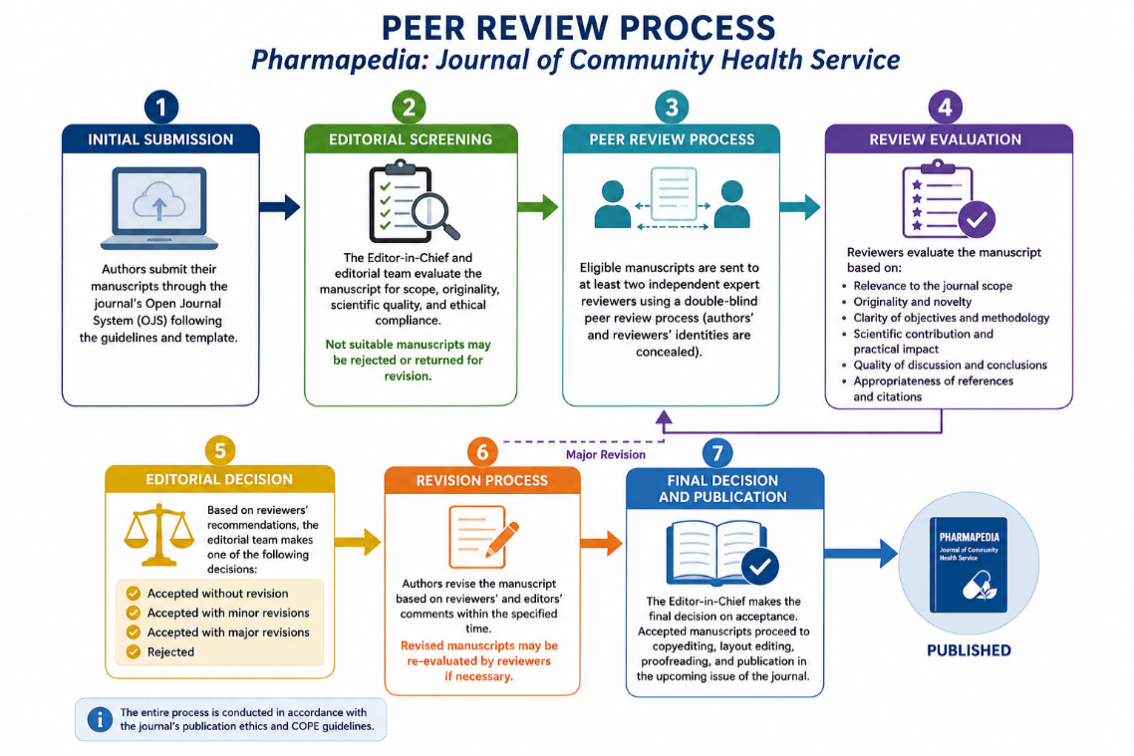
All manuscripts submitted to Pharmapedia: Journal of Community Health Service will undergo a peer-review process to ensure the quality, originality, and scientific contribution of the published articles. The review process is conducted through the following stages:
Prohibition on the Use of Artificial Intelligence (AI)
Reviewers are strictly prohibited from using Artificial Intelligence (AI), including generative AI tools and Large Language Models (LLMs), to evaluate, analyze, or formulate recommendations regarding manuscripts under review. Manuscripts, data, figures, tables, research findings, and any other information contained in the manuscript are confidential materials and must not be uploaded to or entered into third-party AI platforms.
Reviewers remain fully responsible for the content, scholarly judgment, comments, and recommendations provided throughout the peer review process. The use of AI for limited administrative assistance or language improvement may be permitted, provided that no confidential information from the manuscript is disclosed and that such use does not replace the reviewer's critical assessment. Reviewers must also ensure that all comments and recommendations submitted reflect their own independent evaluation and scholarly judgment.
Violations of this policy may be considered breaches of confidentiality and the integrity of the peer review process. Such violations may also be taken into consideration by the editor when determining a reviewer's eligibility to participate in future peer review activities.