







Bussiness, Accounting and Knowledge Journal
Organized by:
Universitas Pekalongan
Contat Person:
Dian Priatiningsih
email: batikfebunikal@gmail.com
Articles consist of a maximum of 8,000 words, including the bibliography. All
of the manuscript sections can be written in English or Bahasa. Articles are typed in Arial, 12 pt, 1.15 line and paragraph spacing, one-column format, and 1-inch margin for all sides. Please allow 280 words for each figure or table.
The Title of the Article Must be Brief, Concise, and Clearly Describe the Substance of the Content [Left align, Arial, 16 pt, maximum 20 words, sentence case]
First author's namea*, second authorb, third authorc, etc maximum 5 authors [Align left, Arial 11pt]
abcdepartment and affiliated university [Left align, Arial, 10pt, italic]
*Corresponding author: author@email.ac.id [Left align, Arial 9pt, underline]
ABSTRACT
The abstract is written in English or Bahasa and must reflect the substance of the study. The abstract must contain information on research objectives, research method, findings, and implications. It has to be written in one paragraph in Arial, 10pt, justify, and single spaces. The total number of words in the abstract must be in the range of 150–300 words, including keywords and article classification. No citations are included in the abstract.
Keywords: 4-6 terms [Left Align, Arial 9pt]
[Keywords must be written alphabetically]
JEL code: 1-4 codes refer to https://www.aeaweb.org/econlit/jelCodes.php?view=jel
[Left Align, Arial 9pt]
Date:
Citation:
1. Introduction
The introduction section describes the background of the research, including the importance of the topic discussed, the state of the art, the gap in the literature, the objectives of the study, the research questions, and the research contribution. Explain systematically what the issue is and why it is important. Does the issue exist in Indonesia, and how? If the object is from another country, also explain why the issue exists in that country. Explain the factors that may influence the issues and what the previous research findings are. Refer to the literature in regard to the issues. Explain the weaknesses of the previous studies. Then, explain the aspects of this research that make it different from previous studies. Explain the research problems clearly, followed by research questions. At the end, please explain the research objectives and contributions. Citations must be included using relevant citation software, such as Mendeley.
2. Theoretical Framework and Hypotheses Development
2.1 Theoretical Framework
2.2 Hypotheses Development
This section contains relevant literature related to the concept and theory used for the proposed hypothesis. The theoretical framework encompasses not just the theory but also the narrative explanation of how the researcher engages in using the theory and its underlying assumptions to investigate the research problem. This section summarizes concepts, ideas, and theories derived from prior research studies that were synthesized in order to form a conceptual basis for the analysis and interpretation of the meaning found within this research. The relationship among those concepts has to be depicted in the form of a conceptual framework, as example shown
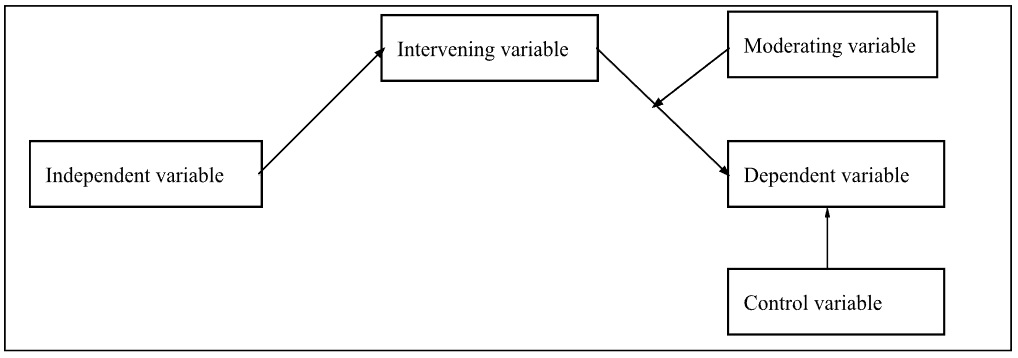
in the Figure 1 below.
Figure 1. Conceptual Framework
For qualitative research, hypothesis formulation may not be necessary. Instead, the author, who uses a qualitative approach, is requested to explain the theory used to build research instruments and discuss the research results.
Based on these arguments, hypothesis 1 can be explained as follows:
H1: Managerial ownership has a positive effect on the company's financial performance.
3. Research Method
3.1 Data Sample Collection
3.2 Technical Analysis and Variable Measurement
The research method section contains research design, population and sample, variable measurement, data collection techniques, research models, and data analysis techniques. An explanation of the theory used will not be included in this section. Focus on telling the main story, stating the main stages of the research, the methods used, the influences that determined the approach, and why the author chose particular samples, etc. Additional details, such as previously published procedures, can be attached in the appendix. Authors are requested to avoid giving too lengthy or detailed explanations about the concepts and terms used as part of the research method. All mathematical or statistical formulas must be written using equation features, not in the form of a picture. Example:
The model for this study can be described in the Equation 1 below:
Equation 1.
FP=α + β1MO+β2AC+β3INDPCOM+β4CSR+β5ITI+е
FP = Financial Performance
α = Constant
β1-β5 = Regression Coefficient
MO = Managerial Ownership
AC = Audit Committee
INDPCOM = The Proportion of Independent Commissioners
CSR = Corporate Social Responsibility
ITI = Information Technology Investment
e = Standard Error
4. Results and Discussion
This section can be written with content regarding descriptive statistics and the assumptions underlying statistical hypothesis testing. The results of the statistical test should be displayed in the form of picture or table. The format of the table is as follows:
Table 1. Descriptive Statistics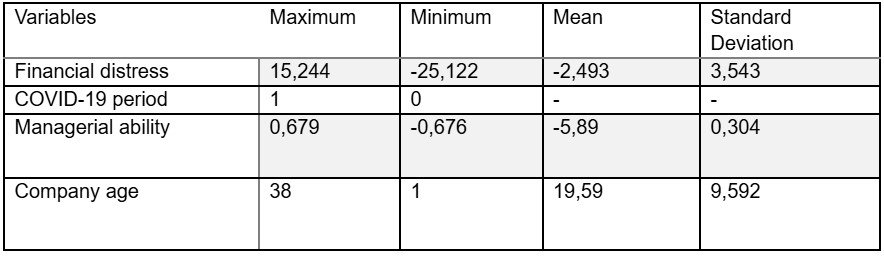
The authors are expected to interpret the results as displayed in the tables and not merely put the figures in the table in paragraphs. After interpreting the results in a comprehensive manner, authors are requested to discuss the results. The discussion is meant to answer the problem statement and research questions. Explain it in the most logical order. What are the really significant facts that emerge? For example, findings that further understanding in the field, those that differ from previous findings, and any unexpected results. Consider presenting key facts in tables or graphs or using images to explain your findings. The research findings must be concluded explicitly. The interpretation of the findings is performed by using existing rationales and relevant theories. Findings in the form of field observation are integrated, linked, or compared with the results of previous studies or with existing theories using references. The discussion of findings must at least contain the elements of what, how, why, and what else.
5. Conclusion, Limitations, and Recommendations
Conclusion, limitations and recommendations should be written in a narrative form and not in bullet or numbering form. The conclusion presents a summary of the results and discussion that refers to the research objectives or answering the research questions. This should explore the significance of the results of the work, not repeat them. Research implications must also be briefly explained either from practical and theoretical perspectives. Authors are also expected to describe limitations of the study followed with suggestions for future research.
Acknowledgement
The acknowledgement section is optional. If authors need to thank certain parties, such as research sponsors, then such statements must be made in a clear and concise manner. Excessive statements must be avoided.
References
Please use the software to manage the references in the whole manuscript. References can be created using the Mendeley application, Endnote, or other citation management software and must refer to the APA 7th style, Arial, 12 pt, single spacing. All references in the article must be included in this section. Primary sources of references, such as articles from reputable international journals, must dominate the references used by the authors. Refer to the up-to-date references as the value-added element for consideration in article acceptance (references used are preferably within the last 10 years).
Appendix
The appendix section is optional. This section contains material that is important to the understanding of the paper but that would disrupt the reader's train of thought if featured in the main body of the article.
Bussiness, Accounting and Knowledge Journal
Organized by:
Universitas Pekalongan
Contat Person:
Dian Priatiningsih
email: batikfebunikal@gmail.com